How to Run a Pickleball Round Robin (Schedule, Scoring & Free Live Leaderboard)
Pickleball round robin schedules, ladder league setup, scoring, printable charts, and a free live leaderboard. Guide for clubs, gyms, and rec centres.
Article Contents
A pickleball round robin is the format that runs almost every club night, gym league, and weekend tournament you've played in. Everyone plays everyone, nobody gets knocked out early, and the standings at the end reward consistency rather than a single hot streak. Whether you're running Tuesday-night doubles at a gym, a co-ed ladder at a community court, or a 32-player tournament at a country club — the round robin (and its sister format, the ladder league) is the format that keeps players coming back.
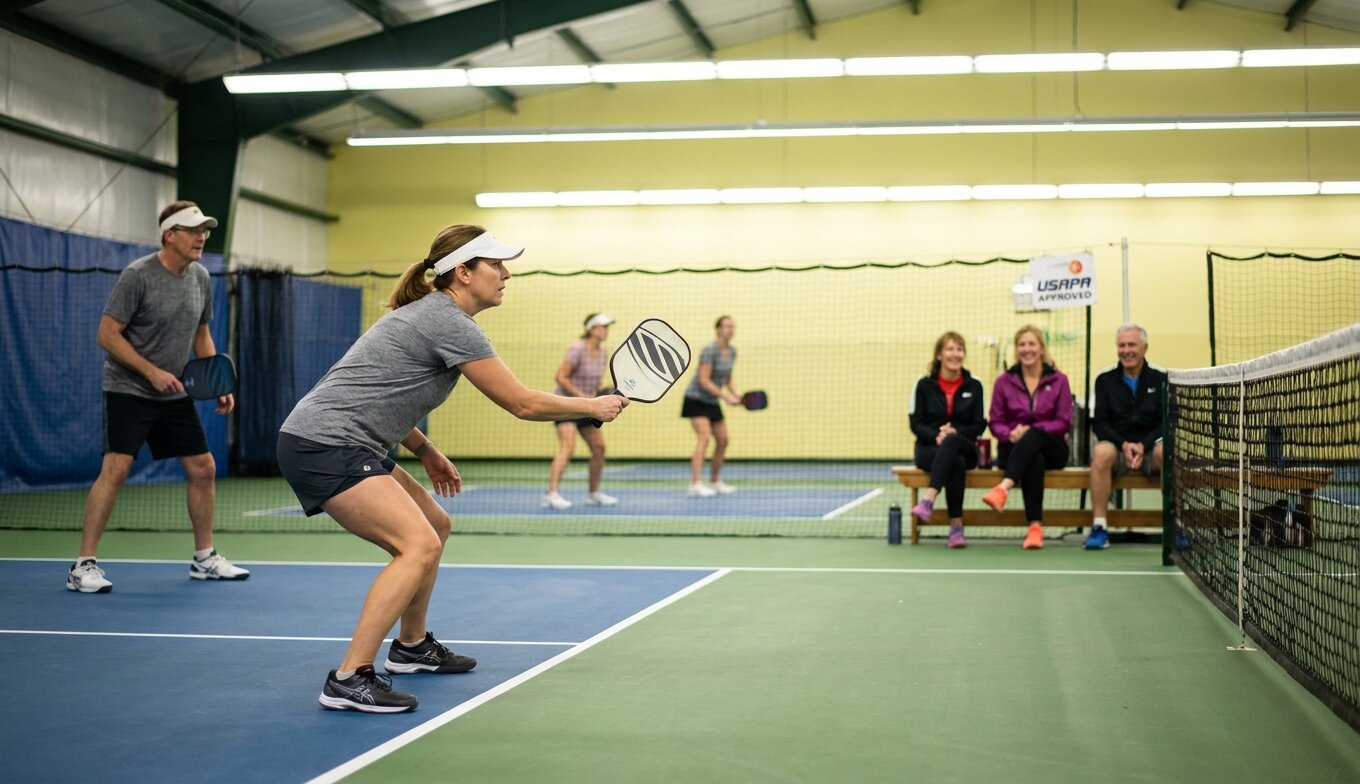
This guide covers round robin schedules (with charts you can use directly), ladder league setup, scoring options, and how to run the standings on a live leaderboard so the whole club can see who's leading the season.
What Is a Round Robin in Pickleball?
A round robin is a tournament format where every player (or team) plays every other player (or team) exactly once. There are no eliminations — everyone plays the same number of matches. Standings are determined by total wins, with point differential as the standard tie-breaker.
For a club, round robin is the default format because:
- Nobody gets knocked out early. A player who loses their first match still has 6 more games to play.
- Every player gets the same amount of court time, regardless of skill.
- The format rewards consistency, not a single hot streak. The best player over the night wins, not whoever happened to draw the easiest first match.
- The schedule is fixed. Players know exactly who they're playing, when, and which court — the organiser doesn't have to redraw a bracket every round.
The trade-off: round robins take longer than single-elimination brackets. With 16 players in singles, a single-elim bracket is 4 rounds (15 matches total). A 16-player round robin is 15 rounds. For most club events, that's a feature, not a bug — players come to play, not to lose in round one and go home.
Round Robin vs Ladder League vs Bracket
Three competition formats, three different feels:
| Format | When to use | Key trait |
|---|---|---|
| Round robin | One-night events, short tournaments | Everyone plays everyone once |
| Ladder league | Ongoing weekly play, season-long ranking | Players move up/down a ranking |
| Bracket (single-elim) | Pure tournaments, large fields | Lose once and you're out |
Round robins are great for club nights, sponsored events, and any context where you want every paying participant to play the same number of matches. The downside is the round count grows quickly with player count.
Ladder leagues are how most gyms and clubs run their year-round programmes. New players can join mid-season at the bottom of the ladder. Existing players climb (or slide) week by week. There's no fixed end date — the ladder just keeps running.
Brackets are the tournament default. Fast to run, but unforgiving. Best when you have 32+ players and a single day to crown a champion.
Many clubs run both round robins and ladder leagues, with quarterly round-robin tournaments deciding seasonal champions on top of a continuous ladder ranking.
How a Pickleball Round Robin Works
Here's the basic mechanic for a single-court, 4-player singles round robin:
- 4 players, 3 rounds.
- Round 1: Player A vs Player B, Player C vs Player D
- Round 2: Player A vs Player C, Player B vs Player D
- Round 3: Player A vs Player D, Player B vs Player C
- Each player plays the 3 others, exactly once.
For doubles, the schedule changes — you're rotating partners, not just opponents. With 4 players in doubles, you can run a "king of the court" rotation where every player partners with every other player exactly once over 3 rounds.
For larger groups (8, 12, 16 players), you need printed charts. The good news: those charts are universal — the same 8-player doubles schedule works at any club anywhere in the world.
4-player doubles rotation
| Round | Court 1 |
|---|---|
| 1 | A+B vs C+D |
| 2 | A+C vs B+D |
| 3 | A+D vs B+C |
8-player doubles round robin (2 courts, 7 rounds)
| Round | Court 1 | Court 2 |
|---|---|---|
| 1 | A+B vs C+H | D+G vs E+F |
| 2 | A+C vs B+D | E+H vs F+G |
| 3 | A+D vs C+E | B+F vs G+H |
| 4 | A+E vs D+F | C+G vs B+H |
| 5 | A+F vs E+G | D+H vs B+C |
| 6 | A+G vs F+H | B+E vs C+D |
| 7 | A+H vs B+G | C+F vs D+E |
After 7 rounds, every player has partnered with every other player exactly once. Final standings are based on total games won. Point differential is the tie-breaker.
(This pattern is a 1-factorization of the complete graph on 8 nodes — also called a "Whist" or "Howell" schedule. The same chart works at any club.)
16-player doubles round robin
For 16 players in doubles, the standard format is 5–8 rounds across 4 courts, played in pools (e.g. two 8-player pools, with the top 2 from each pool advancing to a 4-player final round robin or single-elimination semis/finals). Most clubs use a printed chart from the USA Pickleball Association tournament playbook, customised to their court count.
Where to find printable schedule charts
You don't need to generate a custom round-robin schedule for most club events — the standard ones for 4, 6, 8, 10, 12, 16 players have been printed in pickleball federation handbooks and tournament organiser packets for years. Run a search for "USAPA round robin schedule chart" or download from the official USA Pickleball tournament resources and pair the chart with a live leaderboard for standings. The pattern: the schedule is fixed and printable. The standings are live, updated, and on a screen for everyone to see.
Scoring a Pickleball Round Robin
You'll be tracking three things per player or team:
- Wins: Total games won
- Losses: Total games lost
- Point differential: Cumulative points scored minus cumulative points allowed
The standings sort first by wins (descending), then by point differential (descending) as the tie-breaker. Some clubs add total points scored as a third tie-breaker, though it rarely matters in practice.
For game length, the two common choices:
- Games to 11, win by 2 — fast pace, fits more matches in a session. The default for club nights.
- Games to 15, win by 2 — more competitive, better for tournaments. Slower pace.
Rally scoring (point on every rally, regardless of who served) is becoming more common at clubs because it speeds the game up and makes it more spectator-friendly. Traditional side-out scoring (only serving team can score) is still the standard for tournament play.
Setting Up a Pickleball Ladder League
A ladder league is the right format for ongoing weekly play. Players are ranked top to bottom; after each session, winners climb and losers slide down. Three things to nail:
Initial seeding
Rank players by their best estimate of skill — use DUPR ratings, USAPA ratings, or club self-reports. The ladder doesn't have to be perfect on day one because matches will resort it within a few weeks.
Movement rules
The simplest set: after each session, win = move up 1 spot, loss = move down 1 spot. More complex variants:
- Challenge ladder: any player can challenge anyone within 3 spots above them. Winner takes the higher position.
- Position ladder: matches are determined by current rank. Position 1 plays position 2, position 3 plays position 4, etc. Winner of each match holds the higher position.
- Pyramid ladder: ranks 1, 2-3, 4-6, 7-10 form pyramid tiers. Players can challenge anyone in their tier or one tier above.
Pick the simplest one your players will follow. Position ladders are the default for most clubs.
Skill divisions
Most clubs split players into divisions by skill (3.0, 3.5, 4.0, 4.5, 5.0+). Each division gets its own ladder. Players who outclass their division get promoted. New players join the bottom of whichever division matches their rating.
Real club examples from Leaderboarded users follow this exact pattern: "Mixed Doubles 3.0/3.5/4.0/4.5/5.0+", "Life Time Folsom Co-ed Intermediate/Advanced League", "Tuesday Pickleball — Pool A Standings", "Monday Pickleball — Pool B Standings". Multiple gym chains run their entire facility leagues this way.
Setting Up Your Pickleball Leaderboard
Most clubs run round robins with a clipboard at the desk. Players walk over after each match, the desk volunteer writes down the score, and the standings are announced from a printed sheet at the end of the night. It works — but it kills the energy. Nobody knows where they stand mid-night, and the desk volunteer has to redo the standings sheet every 30 minutes if anyone wants an update.
A live leaderboard fixes this. Set up a multi-metric board tracking wins, losses, and point differential per player or team. Update scores after each round on a phone. The leaderboard updates everywhere — TVs at the club, players' phones, the embed on the club's website — within seconds. Players check their position between rounds without bothering the desk volunteer.
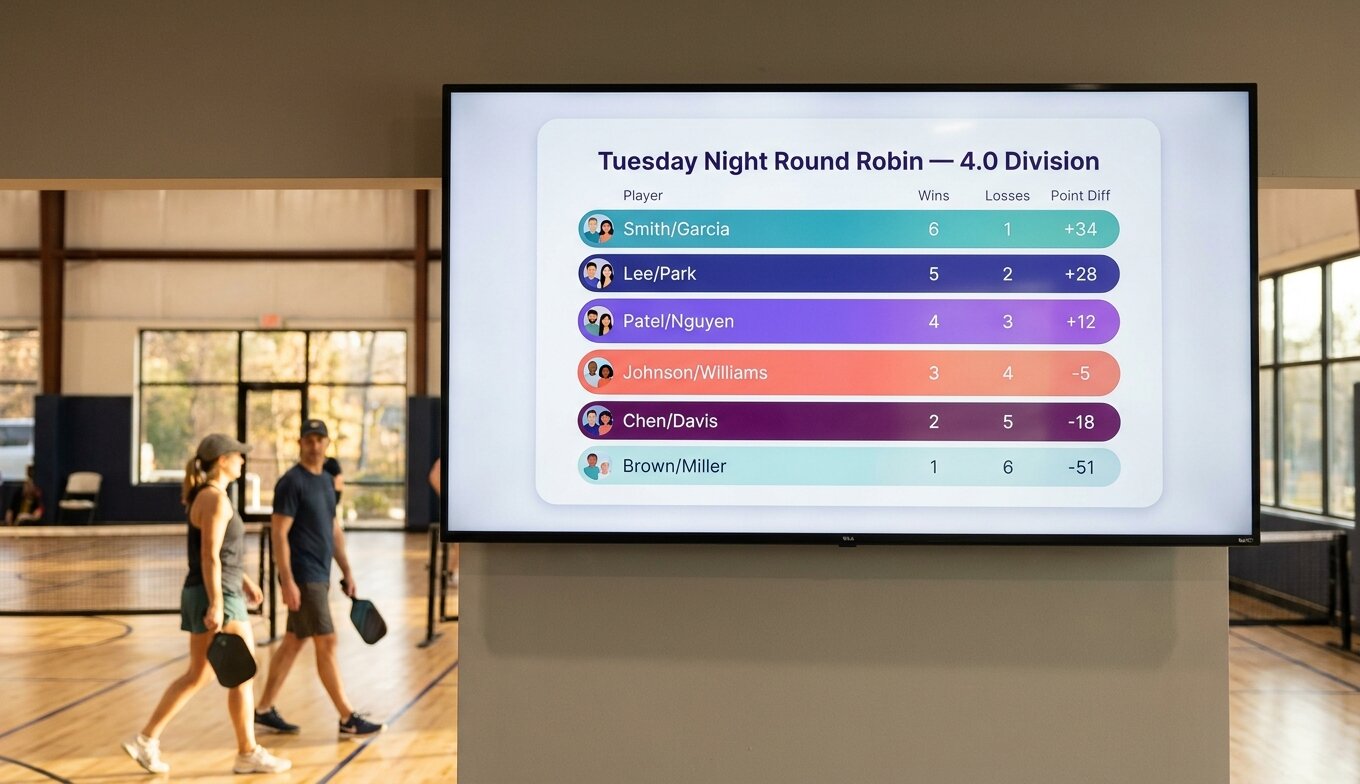 A multi-metric pickleball round robin leaderboard built with Leaderboarded
For a round robin or ladder league, use a multi-metric leaderboard — pickleball naturally has multiple stats worth tracking (wins, losses, point differential, sometimes win percentage) and you'll want all of them visible.
Capture Additional Participant Information
When adding or editing participants, you can optionally capture extra information like email addresses, organization names, and custom fields. This information:
- Is never visible on the public leaderboard
- Appears only in your admin view
- Is included when you download your data as CSV
- Perfect for lead generation at trade shows, contests, and events
Learn more: See our complete Participant Data Capture documentation for setup instructions, use cases, and privacy guidelines.
This feature requires activation. Contact us to get started or request additional custom fields.
A few setup notes specific to pickleball:
- Rows = players (singles) or teams (doubles). For doubles, decide upfront whether the team is fixed (Player A always partners Player B) or rotating (every round = different partner).
- Columns: Wins, Losses, Point Differential. Sort by Wins descending; use Point Differential as the visual tie-breaker.
- For ladder leagues, use a single-score leaderboard with player names sorted by current rank. Update positions after each session.
- Use the TV display mode for the club entrance. The TV leaderboard guide covers full-screen mode and auto-scrolling between divisions.
- Use the embed code to put the live ladder on the club's website. Members and prospective members both follow it.
- Print the QR code on the desk-volunteer clipboard so players scan it for live standings.
After the round robin
When the last match ends:
- Confirm standings with the players. Show the leaderboard on the TV; let players double-check their wins/losses against the score sheets.
- Lock the leaderboard so no further edits are made.
- Announce the winners — gross winner of the night (most wins), and runner-ups by point differential.
- Save the URL — the standings become a record. Next time you run the round robin, players will look up where they finished last time.
- For ladder leagues, update positions for the new week — winners up, losers down — and reset the leaderboard for next session.
Real Pickleball Leagues Running on Leaderboarded
A snapshot of recent pickleball league boards on the platform:
- Life Time Folsom Co-ed Intermediate/Advanced League — gym chain running facility-wide leagues with skill-tiered divisions
- Mixed Doubles 3.0/3.5/4.0/4.5/5.0+ — divisional ladder leagues at multiple clubs
- Tuesday Pickleball — Semifinals and Monday Pickleball — Pool B Standings — weekly club-night round robins with pool play
- Life Time Team Pickleball 14/16/18/20+ — youth pickleball leagues by age group
The pattern that works best for ongoing pickleball leagues: a multi-metric leaderboard with wins/losses/point-differential, divided by skill level, displayed on a TV at the club entrance, and embedded on the club's web page so the whole community can follow standings between sessions.
Run the round robin or ladder consistently for a season, and the leaderboard becomes part of the club's identity. New members joining mid-year scroll back through the standings to see who's been winning. Returning players check their year-over-year rank. The board is the season.
Common Questions About Pickleball Round Robins and Ladder Leagues
"What is a round robin in pickleball?"
A round robin is a tournament format where every player (or team) plays every other player (or team) exactly once. There are no eliminations — everyone plays the same number of matches. Final standings are determined by total wins, then by point differential as a tie-breaker. Round robins are the default format for club nights and gym leagues because nobody gets knocked out early, every player gets the same amount of court time, and the standings reward consistency rather than a single hot streak.
"What is a pickleball ladder league?"
A ladder league is an ongoing competition where players are ranked top to bottom — like rungs on a ladder. After each session, players who win move up the ladder and players who lose move down. Unlike a round robin, a ladder runs continuously over weeks or months, and matchups are determined by your current ranking rather than a fixed schedule. Ladder leagues are the default format for gyms and clubs that want a season-long competition without committing to a fixed bracket.
"How does a 4-player pickleball round robin work?"
With 4 players, there are 3 rounds, each with 2 simultaneous singles matches (or 2 doubles pairings). Round 1: A vs B, C vs D. Round 2: A vs C, B vs D. Round 3: A vs D, B vs C. Each player plays 3 matches against the 3 other players. For doubles, every player partners with every other player exactly once across the 3 rounds. This is also called the 'King of the Court' rotation when used for one court with rotation.
"How does an 8-player doubles round robin work?"
With 8 players in doubles, you have 7 rounds, with 2 simultaneous matches per round (4 players per match × 2 matches = 8 players each round). Across the 7 rounds, every player partners with every other player exactly once. You'll need 2 courts running in parallel. The full schedule fits on a single printed chart that everyone can follow without confusion.
"What's the difference between a round robin and a ladder league?"
A round robin runs over a single session or short series and produces final standings — once everyone plays everyone, you're done. A ladder league runs continuously, with players moving up or down the ranking after each session. Round robins are great for one-night events. Ladder leagues are great for ongoing weekly play at a club. Many clubs run both: a weekly ladder during the season, and a quarterly round-robin tournament to crown a champion.
"How long does a pickleball round robin take?"
For a session with 8 players (doubles, 7 rounds, games to 11), expect about 2 hours including warm-up. With 12 players over 2 courts, plan for 2.5 hours. With 16 players over 4 courts, you can fit a full round robin in 2.5 hours. Use games to 11 for fast pace, games to 15 for more competitive play.
"What's the best way to track pickleball league standings?"
A live leaderboard beats clipboards and whiteboards. A multi-metric leaderboard tracks wins, losses, and point differential for every player or team, updates in real time as scores come in, and can be displayed on a TV at the club. Players check standings on their phones between rounds; new players walking by see what's on offer. The board you set up at the start of the season carries through to the finale.

Written by Caspar von Wrede
Founder of Leaderboarded. Building tools that help teams track progress and stay motivated.