15 Office Scavenger Hunt Ideas Your Team Will Actually Enjoy
15 office scavenger hunt ideas for team building, onboarding, and office parties — with a ready-to-use item list, sample riddles, and a live leaderboard to keep score.
Article Contents
An office scavenger hunt is one of the few team activities that needs no budget, no bus, and no trust falls. Done well, it gets people away from their desks, talking to colleagues they never talk to, and competing over something gloriously unimportant.
The trick is picking the right format for your team. Below are 15 office scavenger hunt ideas — from a classic item hunt (ready-to-use list included) to riddle trails, onboarding hunts for new hires, and a QR code version that scores itself on a live leaderboard.
How to run an office scavenger hunt
Whatever format you pick, the skeleton is the same:
- Choose teams — pairs or groups of 3–4 work best, ideally mixing departments.
- Set a time limit — 30–45 minutes keeps the energy up without eating the afternoon.
- Write your list, clues, or checkpoints — steal freely from the ideas below.
- Decide how you'll score — paper works, but a live leaderboard on the office TV turns a nice activity into an actual competition.
- Offer a prize — even a traveling trophy or the good parking spot for a week.
For a full setup walkthrough, see our guide on how to make a QR code scavenger hunt.
The 15 ideas
1. The classic item hunt
Teams race to collect real objects from around the office. Here's a ready-to-use office scavenger hunt list — copy it as-is or swap in your own inside jokes:
- A business card that isn't yours
- A pen from a hotel or conference
- A coffee mug with a slogan on it
- The oldest coin anyone can find
- A phone charger that fits nobody's phone
- A snack past its best-before date
- Something with the company logo on it
- A handwritten note
- A takeout menu
- A cable nobody can identify
- A stapler (bonus points if it's red)
- A book (extra point if the owner signs it)
- A real plant — not plastic
- A printed photo
- An umbrella
- Five rubber bands
- A birthday card
- A Post-it with something genuinely important written on it
- Something purple
- A receipt from the vending machine or office kitchen
One point per item, and the team with the most points when the timer sounds wins.
2. The riddle trail
Instead of a list, teams solve office scavenger hunt riddles where each answer is a place or object — and the next clue is waiting there. Eight starters:
- I have keys but can't open a single lock. (keyboard)
- I'm full of beans every morning — and so are you, after visiting me. (coffee machine)
- I hold a hundred ideas, but wipe me clean and I forget them all. (whiteboard)
- I eat paper and spit out confetti. (shredder)
- I'm the coldest gossip spot in the building. (water cooler)
- Everyone signs me when someone leaves. Nobody reads me twice. (farewell card)
- My one job is ups and downs. (elevator)
- Feed me a coin or a code, and dinner falls with a thunk. (vending machine)
3. The QR code checkpoint hunt
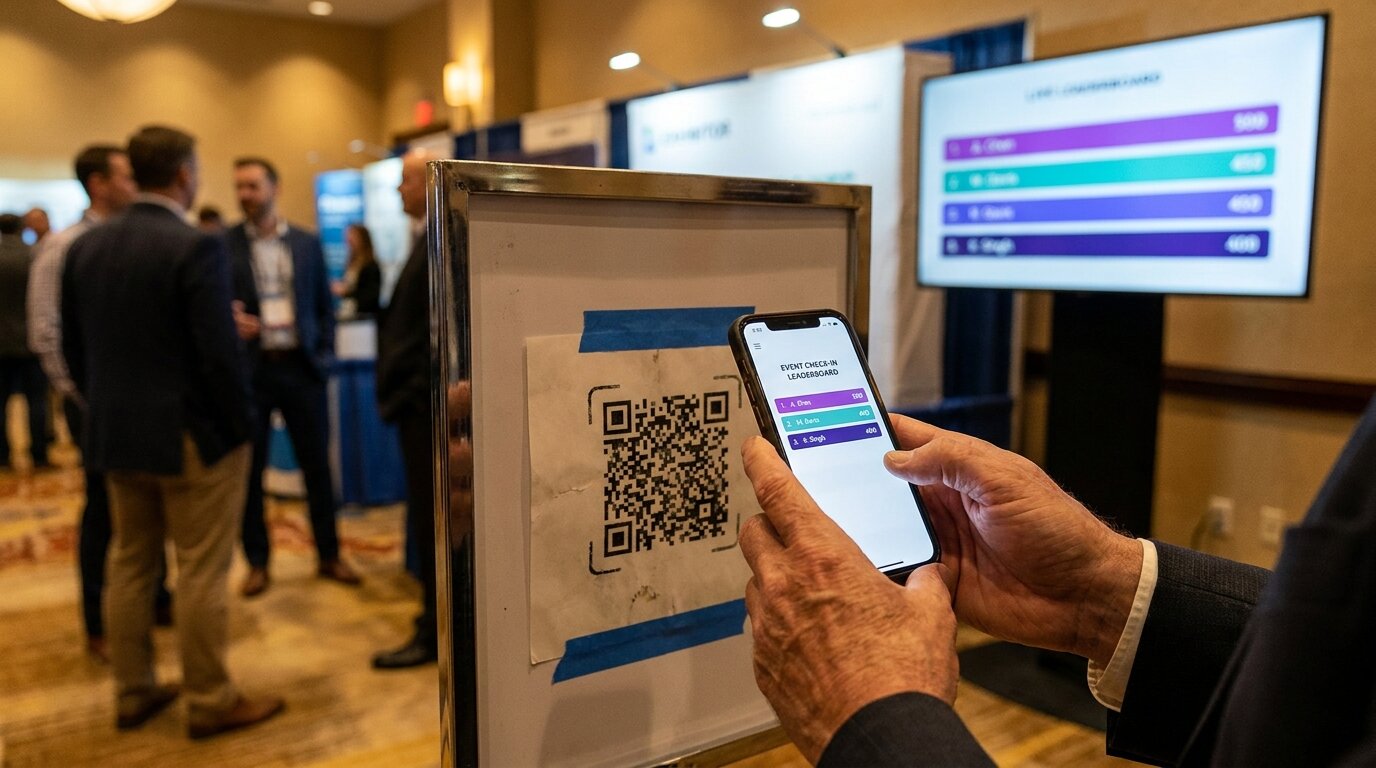
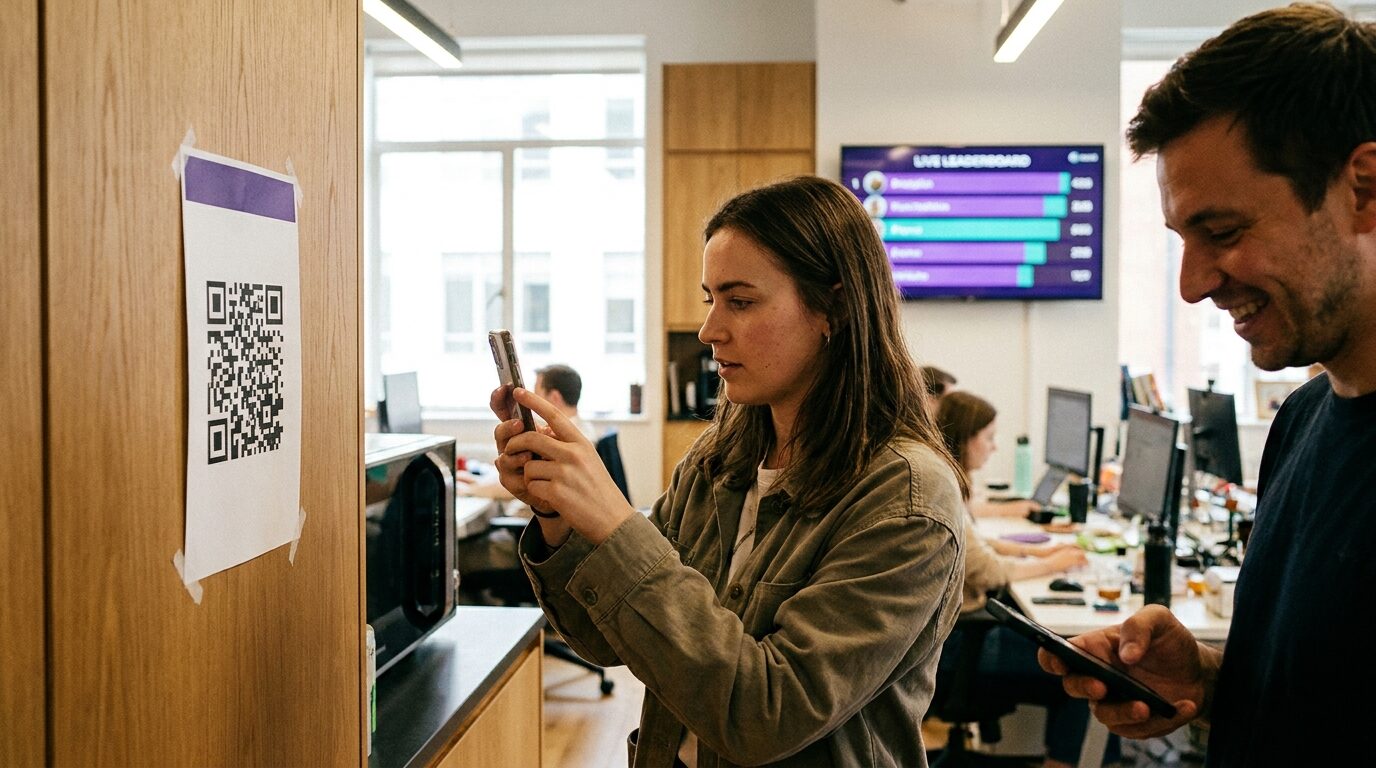
The modern version: put a QR code at each checkpoint instead of a clue card. Participants scan with their phone camera, each scan checks them in and awards that checkpoint's points, and a leaderboard updates live on the office TV — no app, no accounts, and nobody has to tally anything. This is the format that scales past one floor. Here's how it works.
4. The new-hire onboarding hunt
An onboarding scavenger hunt beats any orientation slideshow. Send new employees to find the printer, the first-aid kit, the good meeting room, and the coffee machine — and to collect a fact from one person on each team. By the end of the hunt they know the building and ten colleagues. Run it every hiring round; the checkpoints never go stale.
5. The department passport
A corporate scavenger hunt for offices where teams never mix: each department is a checkpoint, and participants must visit them all and complete a mini-task at each — learn what the team is working on, get a signature, answer a one-question quiz. Great for company anniversaries and all-hands days.
6. The office photo hunt
Swap collecting for photographing: recreate the company logo with office supplies, snap the best mug in the kitchen, capture a desk that looks like nobody works there. We've collected 50 prompts in our photo scavenger hunt ideas — including a section just for offices.
7. The company trivia hunt
Hide numbered clue cards around the office, each with a question about the company: the founding year, the first product's name, the most-ordered lunch. Teams hunt the cards and earn points per correct answer. Sneakily good onboarding for veterans, too.
8. Whose desk is it?
Pick ten desks (with permission) and write a clue about each owner — "this person has run three marathons", "this person once met a Bond actor". Teams match clues to colleagues. It's the fastest way to turn desk neighbors into actual acquaintances.
9. The time-capsule hunt
For companies with a little history: teams hunt down the oldest artifacts still in the building — the first product box, a photo from the old office, a brochure with the previous logo, the ancient fax machine IT refuses to throw out. Finish with a show-and-tell.
10. The holiday hunt
A Christmas office scavenger hunt writes itself: hide ornaments, find the desk with the most decorations, locate the secret candy cane stash. Works equally well for Halloween (hidden plastic spiders) or a spring egg hunt. Seasonal props do half the organizing for you.
11. The remote-team hunt
A virtual office scavenger hunt runs entirely on video call: "bring back something older than you", "a mug you'd never use in the office", "the most impressive cable tangle in your house". First one back on camera with each item scores. Remote teams need the silliness most.
12. The lightning round
Ten minutes, one list, no leaving the floor. Best run as a recurring Friday ritual with a rolling score — the leaderboard carries over week to week, which keeps the rivalry alive far longer than a one-off event.
13. The neighborhood lunch hunt
Take it outside: a menu item under $10, a shop older than the company, street art, the best coffee within five blocks. Ends at a reserved table somewhere, which is the real prize.
14. The puzzle chain
Escape-room logic, office edition: each solved clue produces a code or keyword that unlocks the next location. Harder to write, unbeatable for bragging rights. Keep it to five or six steps or lunch will be involved.
15. The good-deeds hunt
Points for acts, not objects: refill the printer, water a neglected plant, write an anonymous compliment, learn how a colleague takes their coffee and deliver it. The rare hunt where the office is left better than before.
Keeping score (without a spreadsheet)
Any workplace scavenger hunt gets sharper the moment the score is public. Instead of tallying a spreadsheet afterwards, put a live leaderboard on the office TV: with a QR Checkpoint Hunt, every checkpoint gets its own printable QR poster, participants scan to check in and earn points, and the board updates in real time. There's no app to install and no template to build — the posters are generated for you, and setup takes about five minutes.
Tips from hunts that worked
- Mix departments in every team. The point is talking to new people; don't let cliques self-select.
- Keep it to 45 minutes. Shorter than you think. Leave them wanting a rematch.
- Mix easy and hard. Everyone should score something; nobody should finish in ten minutes.
- Announce the leaderboard loudly. Mid-hunt standings ("Team Kowalski takes the lead!") do more for energy than any prize.
- Photograph the winners. A hall-of-fame channel post is the cheapest trophy there is.
Looking for more formats for adult teams — city-wide hunts, mystery nights, foodie trails? See our 10 team-building scavenger hunt ideas. And if you want regular inspiration for office games, sign up for our newsletter.

Written by Caspar von Wrede
Founder of Leaderboarded. Building tools that help teams track progress and stay motivated.