Board Game Tournament Leaderboards
Run a board game tournament with a live digital leaderboard. Track wins, scores, and rankings across rounds — Catan, Settlers, Scrabble, dominoes and more.
Article Contents
Board game tournaments have a scoring problem that most sport tournaments don't: the games are wildly different. A Catan game ends with a point total. Chess ends with a win or loss. Scrabble produces a score; Ticket to Ride produces a score; Dominion produces a score — but none of them mean the same thing.
Before you build a leaderboard, you need to decide which ranking format fits the games you're running.
Ranking Formats
Points-Based Rankings
For games with meaningful score totals (Scrabble, Ticket to Ride, Wingspan), track cumulative points across rounds. A player who scores 78 in round 1 and 92 in round 2 has 170 total — straightforward to track and rank.
This works well for single-game-type tournaments. It breaks down when you're mixing games with different scoring scales.
Win/Loss Rankings
For games where you're measuring wins rather than points (Chess, Go, most elimination formats), track wins and rank by win count. Tiebreaker: head-to-head record, then score differential if the game produces a score at all.
Swiss-system tournaments use this format effectively — players are paired by win count each round, so you keep matching people of similar ability without running a full round-robin.
Round Robin Scoring
Round robin works well for small groups (up to 8-10 players) where you want everyone to play everyone else. Each player plays each other player once; points or wins accumulate across the full set of games.
The limitation: round robin gets slow quickly. Eight players means 28 total games. For larger groups, Swiss is usually more practical.
Hybrid: Win Points Plus Score Differential
The most flexible format for mixed-game tournaments: award 3 points for a win, 1 for a draw, 0 for a loss — then use score differential as the tiebreaker. This separates players with the same win count without requiring a complex playoff.
Setting Up Your Tournament Leaderboard
Create a participant for each player or team, then add scores after each round. The leaderboard re-ranks automatically as you update.
For round-robin formats where you want a full match history visible, use a scoresheet — it shows each opponent as a column, so the complete results matrix is visible at a glance rather than just cumulative totals.
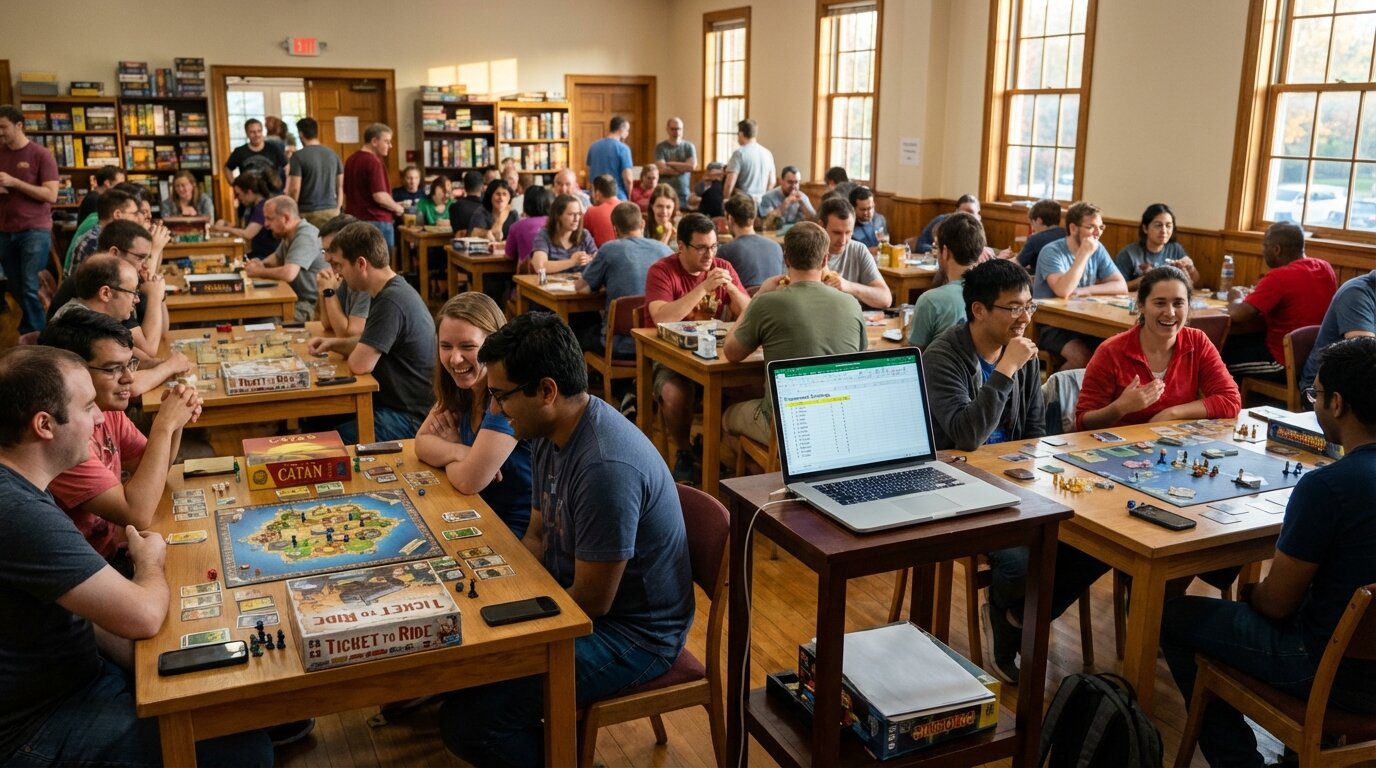
Put the leaderboard on a TV or monitor at the venue so players can check standings between rounds. Add &show_search=false to the URL for a clean display. The TV display guide covers the full URL parameter options.
What Works for Multi-Game Events
If you're running a tournament across multiple game types — a "best of three games" event where players compete at Catan, Codenames, and Blokus — you need a format that normalizes the different scoring systems.
The easiest approach: convert each game to a rank, then average the ranks. First place in each game gets 1 point, second gets 2, and so on. Lowest total rank wins. This sidesteps the problem of comparing a Scrabble score to a Catan score entirely.
For more on running competitive events with digital leaderboards, see the esports tournament guide and scorekeeping for virtual competitions.

Written by Caspar von Wrede
Founder of Leaderboarded. Building tools that help teams track progress and stay motivated.