Sales Contest Leaderboard Guide
Run motivating sales competitions with live leaderboards. Covers contest structures, point models, and metric selection.
Article Contents
A sales contest is different from an ongoing leaderboard. The ongoing leaderboard is always there — it's the ambient score of who's winning the year. A contest is a sprint. It has a start date, an end date, a specific goal, and ideally a prize worth chasing. That difference in structure changes everything about how you design it.
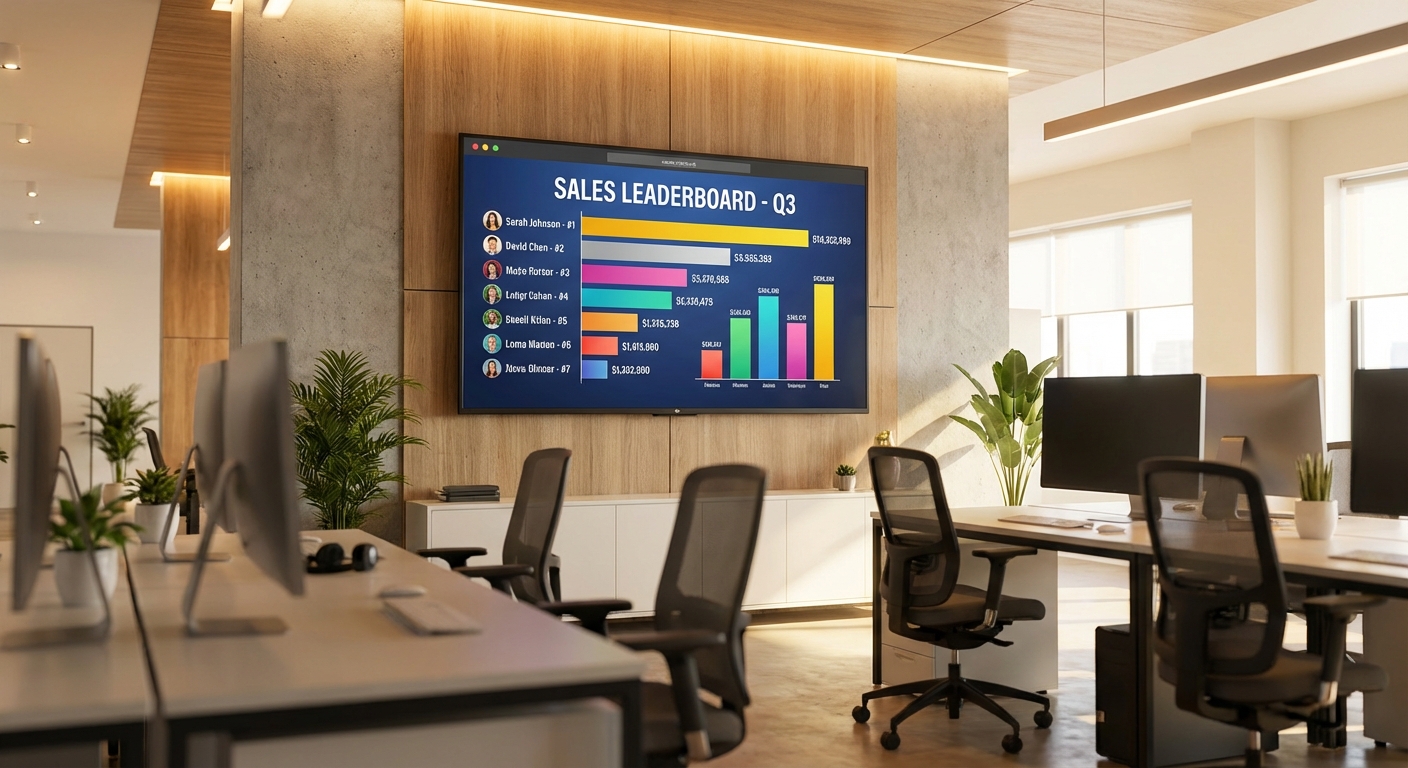
 A time-bounded sales competition displayed live for the whole team.
The biggest mistake managers make is running a contest that's really just a repackaged version of the normal leaderboard. "Most revenue this month, winner gets a gift card." That's not a contest — it's a renamed quota. Whoever was already winning keeps winning. Everyone else disengages by day three.
Good contests change the playing field. They reward a different metric than usual, give everyone a real shot, and end before people lose interest.
Contest Structures That Actually Work
Individual vs. Team
Individual contests drive personal accountability. Every rep knows exactly where they stand and exactly what they need to do. The risk is that top performers lap the field early and the bottom half mentally checks out.
Team contests spread the pressure and build collaboration. A rep who's struggling on calls will hustle harder if they know their team is counting on them. The downside: your top performer can't carry a weak team alone, which can feel unfair.
The hybrid approach — track both individual scores and team totals — is worth the extra setup. It keeps individual accountability intact while giving people a reason to help each other.
Quota-Based vs. Activity-Based
Quota-based contests measure outcomes: revenue closed, deals won, units sold. They're clean and hard to game. The problem is they favor reps with stronger territories, bigger existing accounts, or longer tenure. A new rep with no pipeline can't win a "most revenue closed" contest in 30 days no matter how hard they work.
Activity-based contests measure effort: calls made, demos booked, proposals sent, LinkedIn connections made. They level the playing field because new reps can compete on activity even when their pipeline isn't mature yet. The risk is teaching people to optimize for the metric — calls get shorter, demos get rushed.
The best contests combine both: activity points for effort, outcome multipliers for results.
Point Models: How to Weight Metrics
Not all activities are equal, and your point model should reflect that. Here's a concrete example for a mid-market B2B sales team:
| Activity | Points |
|---|---|
| Outbound call connected | 1 |
| Discovery meeting booked | 5 |
| Demo completed | 10 |
| Proposal sent | 15 |
| Deal closed (under $10k) | 50 |
| Deal closed ($10k–$50k) | 100 |
| Deal closed (over $50k) | 200 |
Revenue is the primary metric — the points should reflect that. A rep who closes one big deal should be competitive with a rep who makes 200 calls. That balance keeps both activity-focused and outcome-focused reps engaged.
Cap the number of categories you track at five or six. More than that and the scoring system becomes a project in itself to administer, and reps lose track of what matters.
 Live standings keep the whole team oriented toward the same goal.
A Concrete Contest Setup
Here's what a two-week sprint contest looks like in practice:
Contest name: "February Blitz" — runs February 3–14.
Goal: Maximize pipeline created and deals closed before Q1 review.
Structure: Individual, with a separate team total board.
Metrics: Discovery meetings (5 pts), demos (10 pts), proposals (15 pts), deals closed (50–200 pts depending on size).
Prize: First place gets a choice of two restaurant vouchers or an extra day off. Second and third get gift cards. Team prize: the winning team gets Friday afternoon off.
Duration: Two weeks is the sweet spot. Short enough that everyone stays engaged, long enough to see real results. Anything over a month loses urgency.
Sharing the Leaderboard
A contest only works if people can see where they stand. Post it everywhere your team already looks.
Slack: Share the presentation link at the start of the contest and drop a standings update at the end of each day. People check Slack constantly — that's where the psychological pressure lands.
Office screen: A TV in the sales floor showing live standings is the most visible option. People walk past it. Visitors see it. It creates ambient competition without anyone having to open an app.
Mobile: Field reps and remote team members need access too. Any link shared from Leaderboarded works on phones — no app download needed.
The presentation link gives read-only access to anyone you send it to. Your admin link stays private.
Setting Up Your Contest Leaderboard
For a contest with multiple scoring categories, a multi-column leaderboard lets you track each activity separately and calculates total points automatically. If you want a head start, browse our leaderboard templates and pick a sales-ready board to customize.
You can set custom point weights for each column, add team logos, and display rankings live. When the contest ends, the leaderboard stays in place as a record — useful when you're running recurring contests and want to compare cohorts.
Pricing
The free tier covers basic leaderboard functionality. Adding your company logo and embedding the leaderboard in an internal portal requires a paid plan. See the pricing page for details.
For ongoing sales tracking beyond individual contests, read the full guide on sales leaderboards. For contest format ideas, sales competition formats covers weekly, monthly, and quarterly structures in more depth. And if you're weighing a dedicated sales gamification platform against running contests on a simple leaderboard, our category overview maps the options.

Written by Caspar von Wrede
Founder of Leaderboarded. Building tools that help teams track progress and stay motivated.