How to Run a Penny Wars Fundraiser (with a Free Live Leaderboard)
Penny wars rules, themes, jar setup, and a free real-time team leaderboard. The complete guide for schools, PTAs, and offices running a penny wars fundraiser.
Article Contents
Penny Wars is the rare school fundraiser that's actually fun. Teams compete to raise the most money — but with a twist: pennies in your jar score positive, and silver coins dropped in a rival team's jar score negative. So the optimal strategy isn't just collecting pennies. It's also sabotaging the competition. That single rule turns a quiet collection drive into a running-down-the-hallway-with-a-handful-of-quarters event, and it's why penny wars boards are one of the most common things we see schools running on Leaderboarded.
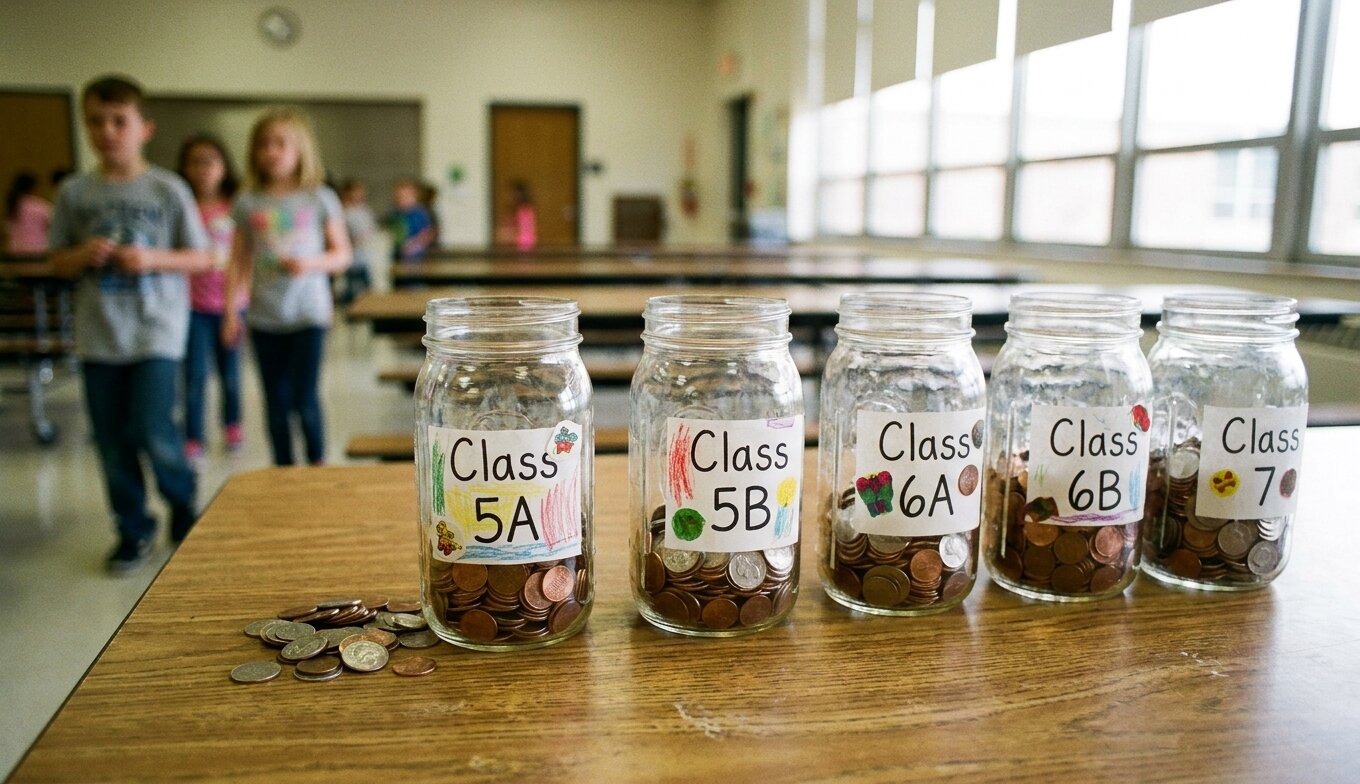
This guide covers the rules, theme ideas, jar setup, a sample week-by-week plan, and how to run the leaderboard so the whole school can see standings update in real time. If you're a teacher, PTA volunteer, student council advisor, or office wellness coordinator who's been handed this fundraiser to run — start here.
What Is Penny Wars?
Penny Wars is a competitive coin-drive fundraiser. Teams (typically classes, grades, or departments) each get a labelled jar. Over the course of about a week, participants drop coins into any jar.
Here's the trick: pennies count as positive points for whichever jar they land in. Every other coin counts as negative points based on its face value. A nickel dropped into your rival's jar subtracts 5 points from their total. A quarter subtracts 25.
That means you fill your own jar with pennies (low-value, positive), and you raid rivals' jars with silver (high-value, negative). The team with the highest net score at the end wins. And — this is the important part — every cent collected, positive or negative, goes to the cause. Sabotage raises money for the charity. There's no losing move.
How Penny Wars Works (the Rules)
Three rules cover the basic format:
- Pennies in your jar = +1 point each
- Silver coins in any jar = subtract their face value from that jar's score (−5 for a nickel, −10 for a dime, −25 for a quarter)
- Dollar bills (optional) = subtract 100 points from that jar's score
Coins can't be removed once dropped. The team with the highest net score at the end wins.
That's it. The whole format works because silver coins are more powerful than pennies (one quarter cancels 25 pennies), but they're more expensive to deploy. So smart teams collect tons of pennies for defence and save up silver for tactical strikes against whoever's leading.
A worked example
Class 5A's jar at the end of the week: - 600 pennies (+600 points) - 8 nickels (−40 points) - 12 dimes (−120 points) - 3 quarters (−75 points) - 1 dollar bill (−100 points)
Net score: +265 points. Total cash raised by Class 5A's jar: $9.35.
Class 5B's jar: - 300 pennies (+300 points) - 2 nickels (−10 points) - 1 dime (−10 points)
Net score: +280 points. Total cash raised: $3.20.
Class 5B wins by 15 points despite Class 5A raising nearly three times as much money — because 5A got hit harder with sabotage. That's the point: the leaderboard rewards strategy, the cause gets the cash either way.
Setting Up Teams and Jars
Three team structures cover almost every Penny Wars setup:
Class vs Class
The most common: one jar per classroom. Works for elementary and middle schools where classes have stable identities. Each homeroom teacher takes charge of their jar, and the competition stays within an age group.
Grade vs Grade
Pool all classes within a grade into one jar (or sum them on the leaderboard). Better for high schools where homerooms are less central, and for K-8 schools where you want to even out class sizes — a grade with five classrooms shouldn't compete one-to-one against a grade with two.
House vs House
If your school uses houses (Hogwarts-style — which actually has a whole guide of its own) or vertical groupings, run Penny Wars between houses. This works especially well for boarding schools, IB schools, and any school with established team identities.
For offices and workplaces: department vs department, or floor vs floor. Same mechanics.
The jar itself
The container matters more than people expect. Three things to get right:
- Wide-mouth and clear. Glass gallon jars (the kind that pickles come in) and clear plastic 1-gallon containers both work. Kids need to be able to drop coins in fast and see the level rising. Coffee cans look practical but you can't see inside, which kills the visual drama. Small Mason jars overflow by Wednesday.
- Tape them down. Tape every jar to the table or counter. Coin jars are top-heavy and someone will knock one over within 24 hours otherwise. A spilled jar is a counting nightmare and the team that loses coins will (rightly) feel cheated.
- Label everything. Each jar needs a big visible label: team name, current standing (updated daily with a sticker or dry-erase number), and a QR code that opens the live leaderboard on phones. A laminated label survives the week.
Penny Wars Theme Ideas
A theme gives the fundraiser identity. It's also what gets shared on social media. Pick one:
Holidays and Seasons
Tie Penny Wars to the calendar. Spooky Coin Wars in October (jars decorated with cobwebs and tiny ghosts), Heart-Shaped Coin Wars for Valentine's Day, Spring Forward in March, Coin Madness during the NCAA tournament weeks.
Cause-Driven Themes
Name the war after what the money is for. Penny Wars for the Library, Pennies for Pizza (where the winning class gets a pizza party), Coins for Causes Week. Specific destinations always raise more than vague "school improvement" goals.
Rivalries
Capitalise on natural divisions. Boys vs Girls (works in middle school where the rivalry is already there), Teachers vs Students (one staff jar, one student jar — students always win and love it), Lefty vs Righty.
Movie or Pop Culture Themes
Battle of the Houses, Avengers vs Villains, Star Wars Coin Wars (Rebels vs Empire), Mario vs Sonic. Posters and team names write themselves.
Twists That Boost Engagement
- Mystery rounds: Hide a "wildcard" rule — at noon on Wednesday, dollar bills count as +1000 instead of −100. Announce it 30 minutes before.
- Reverse hour: For one hour at the end, pennies subtract and silver adds. Watch the chaos.
- Sabotage-only Friday: On the last day, only silver coins and bills count. Defensive penny-hoarding is over.
- Bounty days: The team in last place gets a 2× multiplier on pennies for one day. Keeps everyone in the running.
The Post-Penny Era
The US Mint stopped producing pennies in 2025. There are still billions of pennies in circulation — Penny Wars isn't going anywhere — but some schools have rebranded the format for a new generation:
- Coin Wars: same mechanic, but framed as nickels (lowest-circulating-value coin) earning positive points and dimes/quarters as sabotage.
- Cents Wars: any coin counts positive in your jar, any bill counts negative in a rival's. Simpler scoring.
- Tap Wars: a digital version where students or parents tap-to-donate on a payment page, with team-tagged transactions. Less tactile, but works for fully-online fundraising.
The leaderboard mechanics — jar-style team standings updating in real time — work for all of these.
Sample 1-Week Timeline
Run it Monday morning to Friday afternoon. Five days is enough for momentum to build without anyone getting bored.
| Day | What happens |
|---|---|
| Friday before | Send permission letter and flyer home with students. Print posters. Set up jars. |
| Monday | Kickoff assembly. Explain the rules with a worked example. Open the jars. |
| Tuesday | First leaderboard update at end of day. Standings posted in classrooms and on TVs. |
| Wednesday | Mid-week update. Encourage parents to send coins from home. Run a "twist" if you've planned one. |
| Thursday | Sabotage day. Highest-energy day — silver coins start flowing. Update the board hourly if possible. |
| Friday | Final coin counts before lunch. Announce the winner at end-of-day assembly. Reveal total raised. |
Flyer and poster templates
The most successful penny wars fundraisers send a flyer home in students' backpacks the Friday before kickoff. Two pages:
- Page 1 — for parents: What it is, what cause the money supports, when it runs, and why their kid is going to start asking for jars of pennies.
- Page 2 — for students: The rules with the worked example above. A drawing of a jar. The team they're on. The QR code to the leaderboard.
Posters around the school with the leaderboard QR code do the rest. Update the standings on the posters every morning so the hallway becomes part of the competition.
Real Penny Wars Campaigns Running on Leaderboarded
Some recent penny wars (and adjacent coin-drive) leaderboards from Leaderboarded users:
- ACES Penny Wars 2026 — class-vs-class fundraising with a daily live update
- PTA fundraising drives at elementary schools across the US — week-long penny wars with grade-level teams
- Office penny wars at small companies — department vs department, with a charity vote at the end to pick the recipient
The pattern that works best: a clear cause, a tight one-week run, and a leaderboard that's visible everywhere — TVs in shared spaces, posters in hallways, a public link in newsletters and emails.
Setting Up Your Penny Wars Leaderboard
Most schools run Penny Wars with a chalkboard tally that gets updated every couple of days. It works, but it kills the strategic element — by the time you find out your class is in second place, the day is over.
A live leaderboard fixes this. Update jar counts daily (or even hourly during a peak-energy day), and every team can see exactly where they stand. The sabotage suddenly makes sense: kids see their team drop from 1st to 3rd because someone slipped quarters into the jar, and the next morning there's a counter-attack. Display the board on a TV in the cafeteria during lunch, post the public link in the morning announcements, embed it on the school website so parents can follow along, and hand the link to the principal so they can shout out standings at assembly. The board updates in real time across every device that has the link open.
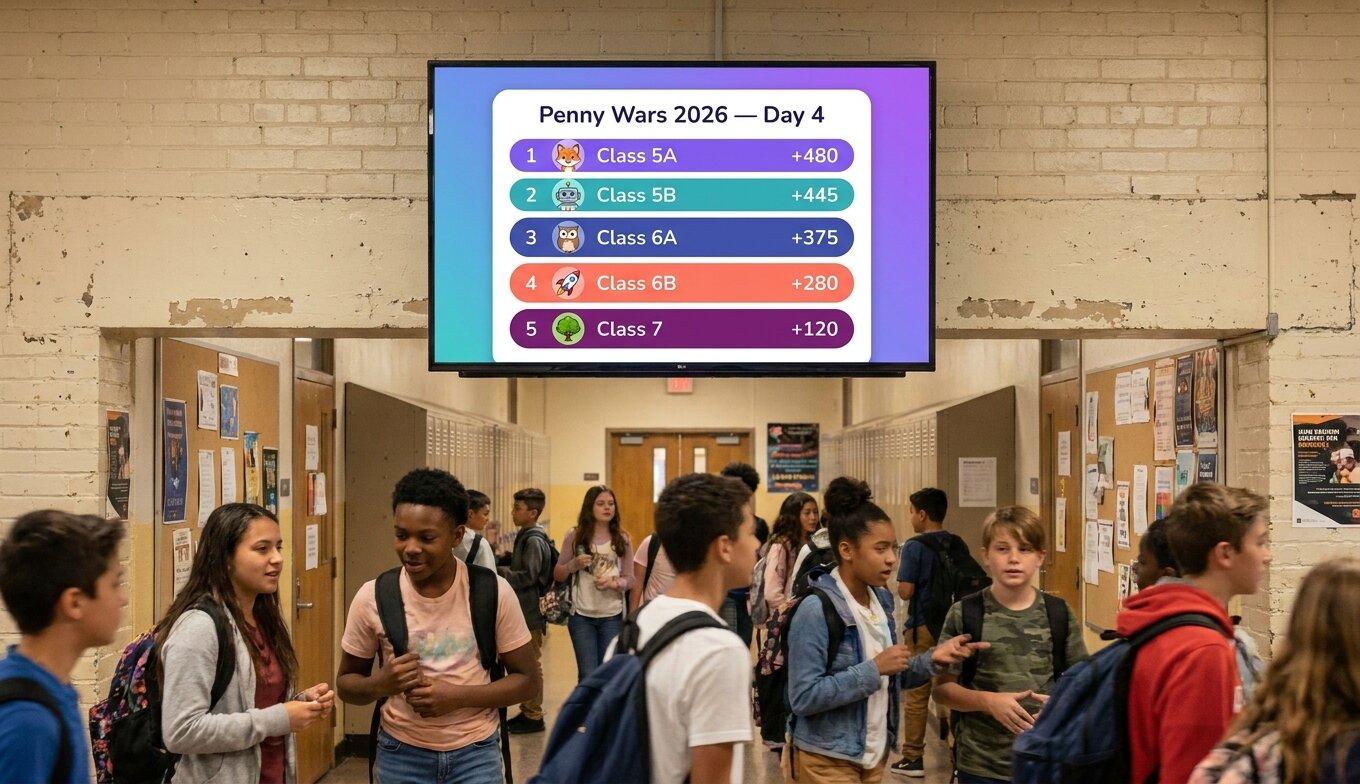 A Penny Wars leaderboard built with Leaderboarded
Create a team leaderboard, add one entry per team, and update scores daily as you sort and count the jars. Set the sort order to "highest score first" — the top of the board should always be the leader.
Capture Additional Participant Information
When adding or editing participants, you can optionally capture extra information like email addresses, organization names, and custom fields. This information:
- Is never visible on the public leaderboard
- Appears only in your admin view
- Is included when you download your data as CSV
- Perfect for lead generation at trade shows, contests, and events
Learn more: See our complete Participant Data Capture documentation for setup instructions, use cases, and privacy guidelines.
This feature requires activation. Contact us to get started or request additional custom fields.
A few setup tips specific to Penny Wars:
- Use the cumulative total display so the whole school can see how much has been raised across all jars combined. The fundraising number is the real win, even if everyone's focused on the rankings.
- Set up a TV display in the cafeteria or main hallway. The TV leaderboard guide covers full-screen mode and auto-scrolling.
- Embed the leaderboard on your school website so parents and former students can follow along and contribute.
- Print the QR code on your posters so phones become an extension of the board.
After the wars
When Friday afternoon arrives:
- Count every jar in front of witnesses (or have students count and a teacher verify). Photograph the totals.
- Announce the final standings on the leaderboard, screen-share it at assembly.
- Reveal the total dollar amount raised across all jars. This is the headline number for the school newsletter.
- Hand the cheque to the cause publicly so the kids see the connection between their pennies (and quarters of sabotage) and the impact.
- Ask the winning team what theme they want for next year's war.
If you run Penny Wars annually, the leaderboard becomes a school tradition. Save the previous-year board as a record so each new cohort knows what they're trying to beat.
Common Questions About Penny Wars
"What is Penny Wars?"
Penny Wars is a school fundraiser where teams (usually classes or grades) compete to fill a jar with coins. Pennies count as positive points for your team — but silver coins (nickels, dimes, quarters) count as negative points based on their value. So you fill your own jar with pennies, and you sabotage rival teams by dropping silver coins into their jar. The team with the highest net score wins.
"How does Penny Wars work?"
Each team gets a labelled jar in a public spot. Over the course of the fundraiser (usually 1–2 weeks), participants drop coins into any jar. Pennies in your own jar = +1 point each. Silver coins in a rival's jar subtract their face value: a nickel = −5 points, a dime = −10, a quarter = −25. At the end, whoever has the highest net score wins. Every cent collected — pennies, silver, and dollar bills — still goes to the chosen cause.
"What are the rules of Penny Wars?"
Three rules cover almost every Penny Wars fundraiser: (1) Pennies in your jar add to your score. (2) Silver coins (and dollar bills, optionally) in a rival's jar subtract from their score. (3) Coins can't be removed once dropped in. Some organisers also add: dollar bills count as −100 (so they're powerful sabotage), the leader at noon each day gets ‘sabotaged’, or rival teams get a 30-minute reverse round at the end.
"How long should a Penny Wars fundraiser last?"
One school week is the sweet spot. Anything shorter and the sabotage dynamic doesn't have time to build; anything longer than two weeks and momentum dies. Run Monday morning to Friday afternoon, and announce the winner at an assembly or on the live leaderboard.
"What containers work best for Penny Wars jars?"
Wide-mouth glass jars or clear plastic containers (1-gallon size) work best — coins are visible, they're hard to tip over, and the silver coins are obvious when sabotage happens. Avoid coffee cans (you can't see inside) and small Mason jars (they fill up too fast for a 1-week war). Label each jar clearly with the team name, and tape it to the table so it doesn't get knocked over.
"Do we still need pennies now that the US Mint has stopped producing them?"
Yes — there are billions of pennies still in circulation, and Penny Wars works fine with the existing supply. Some schools have rebranded as ‘Coin Wars’ where the lowest-value circulating coin earns positive points and higher-denomination coins act as sabotage. The mechanic is identical; only the label changes.
"How do you tally Penny Wars scores fairly?"
You can't shortcut this with a kitchen scale — Penny Wars scoring depends on the count of each denomination (pennies positive, silver coins negative by face value), not total weight. Two jars of similar weight can have wildly different scores. The reliable method is to sort each jar by denomination at the end of the day (or have students sort during a homeroom session), count each denomination, and enter the totals on a live leaderboard. Coin-counting machines at most banks will sort and count for free if you have an account, which is a fast option for big jars. Whatever you do, post the running totals daily so every team can see where they stand — the daily updates are what make sabotage worth it.

Written by Caspar von Wrede
Founder of Leaderboarded. Building tools that help teams track progress and stay motivated.