How to Run a Golf Scramble (Rules, Format, Team Names & Free Live Leaderboard)
Golf scramble rules, format variations, scoring, team names, and a free live leaderboard. The complete planning guide for charity outings and club tournaments.
Article Contents
A golf scramble is the format that runs almost every charity golf tournament you've ever attended. Four players, one team, everyone tees off, you pick the best ball, all play from there, and the team records one score per hole. It works because mixed-skill groups can play together without the beginner ruining the day for the scratch golfer — bad shots get discarded, good shots count for everyone.
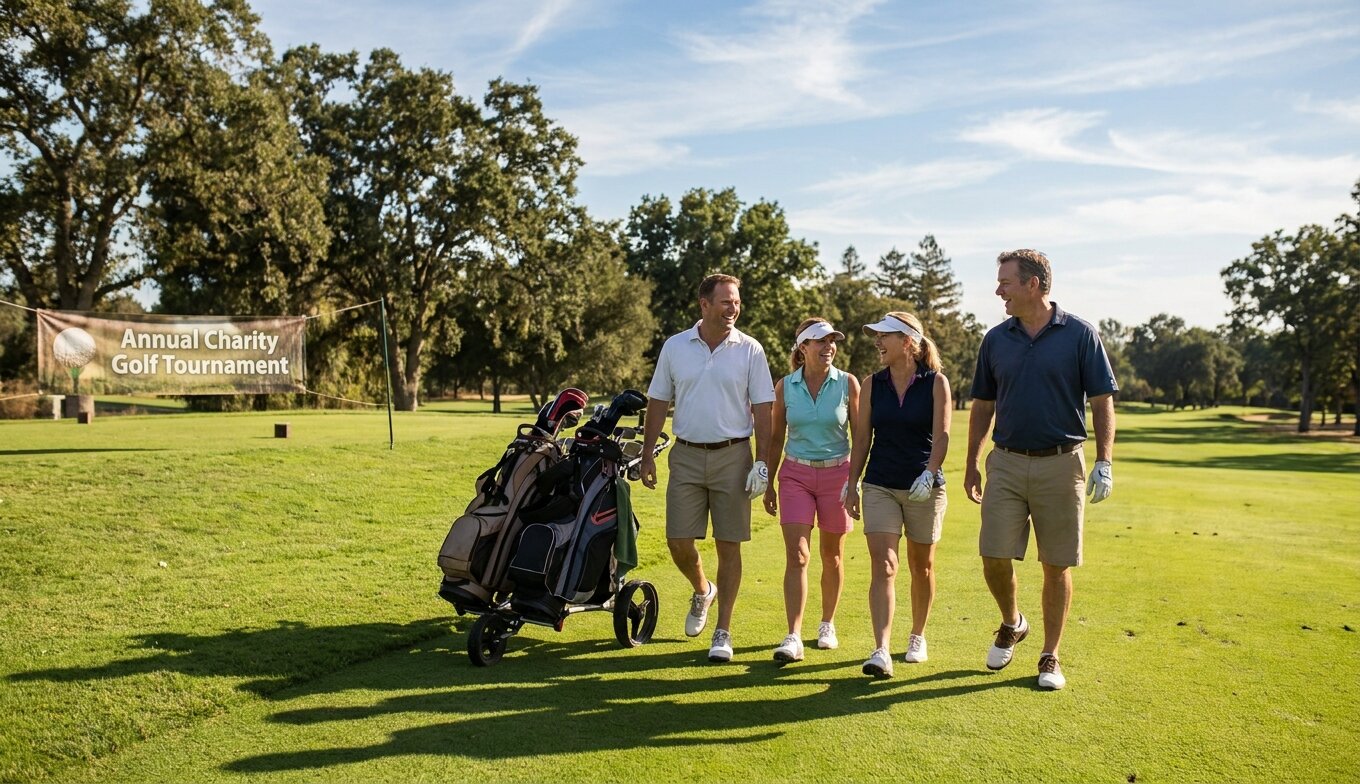
This guide covers the rules, format variations, scoring, handicapping, team-name ideas, prize structure, and a sample run-of-day for organisers. If you've been handed a charity outing or club scramble to run, start here.
What Is a Golf Scramble?
A scramble is a team-format competition where every player on the team plays from the team's best ball on every shot. Most scrambles are 4-person, played over 18 holes, with a shotgun start.
The format works like this:
- All four players tee off
- The team picks the best of those drives
- All four play their second shot from within a club length of that mark, in the same condition (fairway, rough, or sand)
- The team picks the best second shot
- Repeat until the ball is in the hole
- Record one score per hole — the team's combined number of strokes
The team with the lowest total score wins. Net scoring (with handicaps applied) is standard at charity events; gross scoring is more common at club championships.
The genius of the format: a beginner doesn't slow the team down. Their bad shots get tossed. Their good shots — even occasional ones — get used by everyone. That's why scrambles are the default for charity outings, sponsor invitations, and corporate golf days.
Scramble vs. best ball
These two formats get confused constantly. Here's the distinction:
| Format | Each player plays... | Per hole, the team records... |
|---|---|---|
| Scramble | From the team's best ball after every shot | One combined score |
| Best ball (four-ball) | Their own ball through the whole hole | The lowest individual score |
A scramble is faster, more social, and better for mixed-skill groups. Best ball is more competitive and rewards individual skill. If your charity outing wants the highest-handicapper to feel useful, run a scramble. If your club championship wants real competition, run best ball.
How a Golf Scramble Works (the Rules)
Five rules cover every standard scramble:
- Every player tees off on every hole. No skipping holes.
- The team selects the best ball after every shot. Mark the spot with a tee.
- All players play their next shot from within one club length of the mark, no closer to the hole, and in the same condition (if the ball was in the rough, every replay is in the rough).
- On the green, the ball is replaced on the spot of the original best shot — no improving the lie. Each player putts; the team records the first ball that drops.
- The team submits one scorecard with one stroke total per hole and a final 18-hole total.
Most scrambles add a sixth rule: a minimum drive requirement. Without it, the team would just use the longest hitter's drive on every hole. Common variants:
- "Each player's drive must be used at least 3 times in the round" (4-person, 18 holes — works out to 12 of the 18 holes)
- "Each player's drive must be used at least once on the front nine and once on the back nine"
- "At least 4 drives per player must be used"
Pick one and put it on the rules sheet. Otherwise expect arguments at the awards dinner.
Format variations
The standard 4-person scramble is the default, but plenty of variations exist:
- Texas Scramble — same as a standard scramble, but with a minimum drive requirement (typically each player's drive must be used at least 4 times per 18 holes). The most common "competitive" scramble at club level.
- Florida Scramble (a.k.a. Step-Aside Scramble) — after each shot, the player whose ball was selected sits out the next shot. The remaining 3 play, then they pick the best, and the player whose ball was used sits out the next shot. Rotates everyone in. Slower, but every player feels involved.
- Las Vegas / Vegas Scramble — a die is rolled at the tee box on each hole. The number determines which team member's drive is used — no choosing the best one. Adds chaos. Popular at vendor outings where the goal is laughs more than competition.
- Ambrose Scramble (Australia) — same scramble format, but with full team handicap applied (rather than a fractional combined handicap). The team handicap is calculated as the sum of all four handicaps divided by 8 (for 4-person teams).
- Bramble / Shamble — hybrid format: everyone tees off and the team picks the best drive (scramble part). After that, every player plays their own ball into the hole (best ball part). The team records the best individual score. Combines the social start of a scramble with the competitive finish of best ball.
- 2-Person Scramble — same rules, two-person teams. Faster pace, more shots per player, harder for beginners. Better for casual weekend rounds than tournament play.
Scoring a Scramble
You'll need to track:
Gross Team Score
Add up every team's stroke total on the 18 holes. Lowest gross wins the gross trophy.
Net Team Score
Subtract the team handicap from the gross. Lowest net wins the net trophy. The USGA-recommended team handicap formula for a 4-person scramble:
- 25% of player A's handicap (lowest-handicap player on the team)
- 20% of player B's handicap (second-lowest)
- 15% of player C's handicap (third-lowest)
- 10% of player D's handicap (highest-handicap player)
Add those four numbers — that's the team handicap. Subtract from gross. Lowest net wins.
A worked example: handicaps 6 / 12 / 18 / 25. Team handicap = 1.5 + 2.4 + 2.7 + 2.5 = 9.1, rounded to 9.
Side Contests
Most charity scrambles include three side competitions, each scored separately and worth their own prize:
- Closest to the pin on every par 3. Players who hit the green write their name and distance from the pin on a card by the green; the closest at the end of the day wins.
- Longest drive on a designated par 5 (usually one for men, one for women). Same rule: write your name on a card if you beat the current leader.
- Straightest drive on a designated par 4. A line is drawn down the middle of the fairway with paint or string; closest to the line wins.
These side contests are where a multi-metric leaderboard pays off — you can show team standings, closest-to-pin standings, and longest drive standings on the same display board.
How to Plan a Golf Scramble — Run-of-Day
A standard charity scramble runs about 6–8 hours from registration to the last cocktail. Here's a working timeline:
| Time | What happens |
|---|---|
| T-6 weeks | Open registration. Send save-the-dates to past sponsors and players. |
| T-4 weeks | Lock the venue, catering, beverage carts, and side-contest sponsors. Start collecting team registrations. |
| T-1 week | Send confirmation emails with arrival time, dress code, parking, and the rules sheet. |
| Event 7:30am | Registration tent opens. Players check in, get goodie bags, drop swing-in raffle tickets. Volunteers get briefed. |
| 8:00am | Putting contest opens (10 minutes per player on a designated practice green). |
| 8:30am | Welcome announcements. Rules briefing — keep it under 5 minutes. Mention the minimum-drive rule explicitly. |
| 8:45am | Teams disperse to their assigned holes for the shotgun start. |
| 9:00am | Shotgun horn. Tournament begins. |
| 9:00am–1:30pm | Play. Volunteers visit each tent every 90 minutes to enter scores into the live leaderboard. Beverage cart rotation. |
| 1:30pm | First teams finish. Move to the clubhouse. |
| 2:00pm | All teams in. Live leaderboard locks. Lunch is served. |
| 2:30pm | Awards announcement. Show the live leaderboard on the projector while announcing winners. Hand out gross/net prizes, closest-to-pin, longest drive, putting contest. |
| 3:00pm | Raffle draw. Auction (if running one). Final fundraising total announced. |
| 3:30pm | Wrap. Photos with the cheque. Sponsors thanked publicly. |
Scramble flyer and rules sheet
A successful scramble registration packet includes:
- Save-the-date flyer — sent 6–8 weeks out. Date, venue, format, registration fee per team, charity beneficiary, sponsor levels.
- Rules sheet — sent 1 week before the event. The 5 core rules, the minimum-drive rule, the side contests, the handicap formula. Keep it to one page.
- Run-of-day card — handed out at registration. Schedule, hole assignments, lunch time, the QR code for the live leaderboard.
Most charities also include the leaderboard QR code on signage at every hole, so players don't have to remember a URL.
Funny golf scramble team names
Half the fun of a charity scramble is the team-name competition. Some that consistently get a laugh:
Golf-pun classics: The Mulligan Brothers, Tee Many Martoonis, Hackers Anonymous, Grip It and Sip It, The Pin Seekers, Bogey Knights, Fore Play, The Lost Balls, Birds of a Feather, Par-Tee Animals.
Office and corporate: Cubicle Crushers, The Out-of-Office Reply, The Slacker Hackers, The Great Drivers (HR theme), Net Profit (finance team), Code in the Hole (engineering team).
Movie and TV: Happy Gilmores, Caddyshack Refugees, The Big Lebowski Tee, Tin Cup Trio, The Greens Mile, Tee-rex.
Pure punchlines: Just the Tip (drivers), Master Baiters (for a fishing-charity scramble), Putt Pirates, The Sandy Bottoms, Whiskey Tango Foxtrot.
The unwritten rule: keep it clean enough that the charity director can announce it from the stage without flinching.
Charity Scramble Fundraising Add-Ons
The round itself is the centrepiece, but most charity scrambles double their take by layering on revenue streams:
Hole sponsorships
$200–$500 per hole gets a corporate sponsor a sign at a tee box. 18 sponsorships = $3,600–$9,000 before the first ball is hit.
Mulligans
$5 per mulligan, sold at registration. 4 per team is standard. 36 teams × 4 mulligans × $5 = $720 from a tiny add-on.
Beat-the-pro
A local club pro stations on a par 3. Anyone whose tee shot beats the pro's wins a prize; if the pro wins, $5 goes to the charity. Volume play, decent margin.
Putting contest
$5 per putt at a designated green, with a small prize for the longest putt sunk that day. 100 putters × $5 = $500, plus it's a fun pre-round event that gets people warmed up.
Live auction at the awards dinner
Foursomes at member-private clubs, signed memorabilia, vacation packages. A skilled auctioneer can pull $5,000–$15,000 in 20 minutes if the inventory is right.
A live fundraising thermometer
Display a fundraising thermometer next to the leaderboard at the awards dinner so guests see the running total as donations are added. The visual urgency drives the last $5,000 of paddle-raise donations.
Real Charity Scrambles Running on Leaderboarded
A snapshot of recent scramble-format boards from Leaderboarded users:
- 18th Annual Toys for Tots Golf Tournament — multi-team scramble with closest-to-pin and longest-drive side boards
- LCE 2026 Mini Golf Masters — corporate mini-golf scramble with multi-metric scoring
- Local "Closest to The Pin" and "Longest Drive" boards — single-event side contests at charity outings
The pattern that works best for charity scrambles: a multi-metric leaderboard with team gross + net + side contests, displayed on a clubhouse TV during the round, and embedded on the charity's website so non-players can follow along.
Setting Up Your Scramble Leaderboard
Most charity scrambles tally scores on a paper sheet at registration, then someone hand-tallies the cards at the end and announces the winners over dessert. It works, but it kills the energy. Teams sit around for an hour after the round wondering if they won.
A live leaderboard fixes this. Volunteers walk the course or sit at the clubhouse entering team scores hole by hole on a phone. Teams see standings update on TVs in the clubhouse before they've even finished their first beer. The closest-to-pin and longest-drive boards update live. The room hums. Display the board on TVs in the clubhouse and registration tent, share a public link so spouses and donors can follow from home, embed the leaderboard on the charity's website as a live event page, and project it on a screen during the awards dinner so the announcement is dramatic. The board updates in real time across every device.
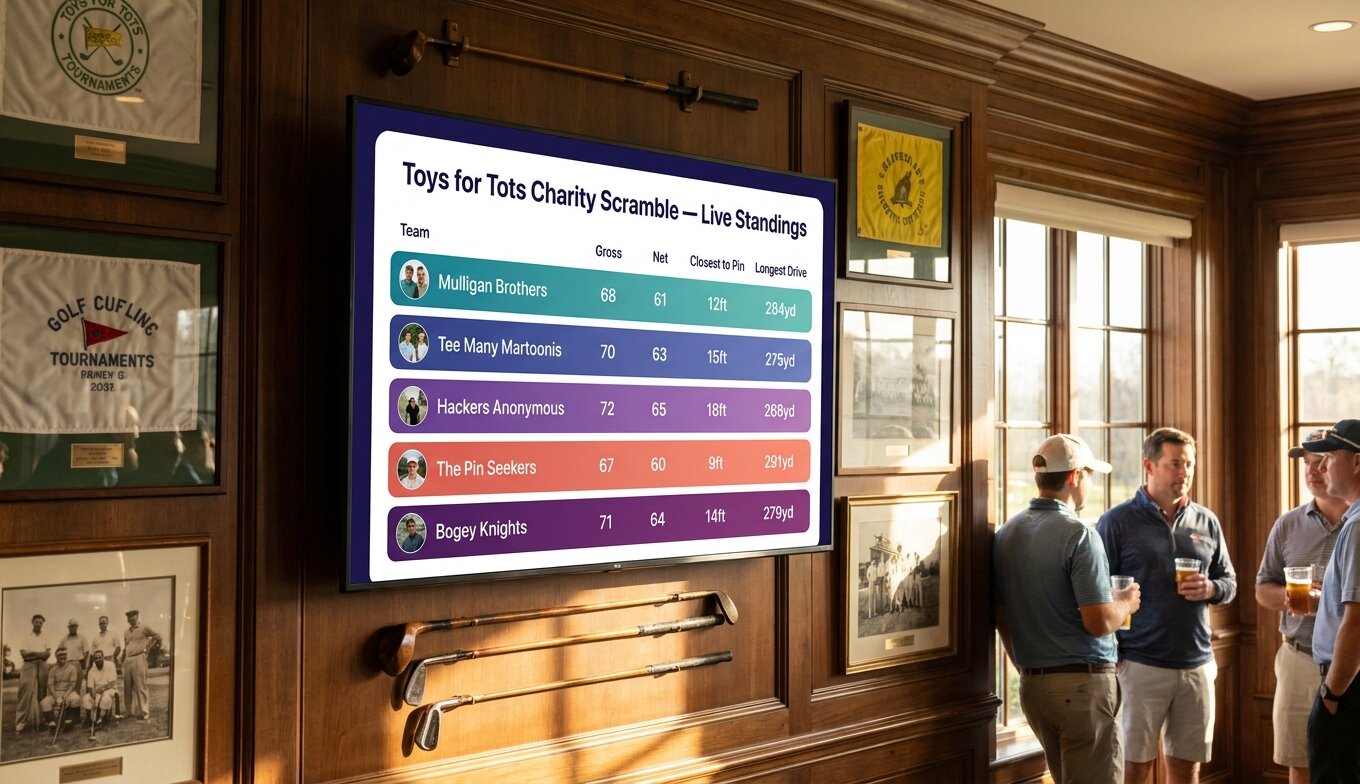 A multi-metric scramble leaderboard built with Leaderboarded
For a scramble, use a multi-metric leaderboard — it's the right board type because scrambles have multiple categories: team gross, team net, closest-to-pin per par 3, longest drive, longest putt. Each is its own column or sub-board.
Capture Additional Participant Information
When adding or editing participants, you can optionally capture extra information like email addresses, organization names, and custom fields. This information:
- Is never visible on the public leaderboard
- Appears only in your admin view
- Is included when you download your data as CSV
- Perfect for lead generation at trade shows, contests, and events
Learn more: See our complete Participant Data Capture documentation for setup instructions, use cases, and privacy guidelines.
This feature requires activation. Contact us to get started or request additional custom fields.
A few setup notes specific to scrambles:
- Rows = teams, not individual players. Each row is one foursome. Add a column for each scoring metric (Gross, Net, Closest to Pin, Longest Drive).
- Sort gross/net ascending (lowest score first). The default is descending — flip it.
- Use the TV display mode for the clubhouse screen. The TV leaderboard guide covers full-screen mode and auto-scrolling between sub-boards.
- Use the embed code to put the live board on the charity's event page so people who couldn't attend can follow along.
- Print the QR code on the rules sheet so players can pull up the leaderboard on their phone between holes.
After the round
When the last team finishes:
- Lock the leaderboard so no more scores can be entered.
- Print the final standings (or screenshot from the TV display) for the awards announcement.
- Announce gross winner, net winner, side contests, and putting contest from the stage. Project the live leaderboard behind the announcer.
- Hand the cheque to the charity publicly.
- Save the leaderboard URL — it becomes next year's "we raised $X with these teams" reference.
If you run the scramble annually, the year-over-year leaderboard archive becomes part of the event's identity. Teams come back to defend their title.
Common Questions About Golf Scrambles
"What is a golf scramble?"
A golf scramble is a team format where every member of the team tees off on each hole, the team picks the best of those drives, and then everyone plays from that spot. They keep doing this — drive, pick the best, all play from the best — until the ball is holed. The team records one score per hole. Scrambles are popular for charity tournaments because they let mixed-skill players compete together: a beginner doesn't drag the team down, because their bad shots get discarded.
"How does a golf scramble work?"
Each team (usually 4 players) plays each hole as one unit. All four golfers tee off, the team picks the best drive, all four play their second shot from that spot, picks the best of those, and so on. The team submits one combined score per hole. The team with the lowest total score across 18 holes wins. Most scrambles also include side contests — closest-to-pin on par 3s, longest drive on a designated par 5 — scored separately.
"What are the rules of a golf scramble?"
Five core rules: (1) Every player tees off on every hole. (2) The team selects the best ball and marks its position with a tee. (3) All players play their next shot from within one club length of that mark, no closer to the hole, in the same condition (rough, fairway, sand). (4) Once on the green, the ball is replaced on the spot of the original best shot — no closer to the hole. (5) The team records one score per hole. Most scrambles also require a minimum number of drives per player (e.g. 'each player's drive must be used at least 3 times in the round') to prevent the team always using the longest hitter's drive.
"What's the difference between a golf scramble and best ball?"
In a scramble, everyone plays from the team's best ball after every shot. In best ball (also called four-ball), everyone plays their own ball through the entire hole, and the team records the lowest individual score on that hole. Scramble = one ball per shot, best ball = four balls per hole. Scrambles are faster and better for mixed-skill groups; best ball is more competitive and better for evenly-matched players.
"How do you keep score in a golf scramble?"
Each team submits a single scorecard with one stroke total per hole and a final total. For tournaments, you'll typically score gross (raw strokes) and net (gross minus team handicap). The team with the lowest net score wins. A live leaderboard like the one Leaderboarded provides lets every team see updated standings in real time as scores come in — which is much more engaging than waiting for the awards dinner to find out who won.
"How long does a golf scramble take?"
An 18-hole scramble usually runs 4–5 hours from the shotgun start, plus an hour for registration and a 1–2 hour awards lunch or dinner afterwards. Total event window: 6–8 hours. Faster than a regular tournament because team scoring eliminates the search for individual lost balls.
"How many golfers should be on a scramble team?"
Four is the standard. Two-person scrambles work for smaller events but the format gets dull because there's less variety in shots. Three-person scrambles split the difference. Some events run five-person teams to fit a corporate sponsor's whole department, but scoring gets long with five tee shots per hole.
"How do you handle handicaps in a scramble?"
The most common method is to take a percentage of each player's handicap and combine them. USGA-recommended formula for a 4-person scramble: 25% of A's handicap + 20% of B's + 15% of C's + 10% of D's, where A is the lowest-handicap player. The total team handicap is then subtracted from the team's gross score to give the net score. This keeps mixed-skill teams competitive — a 4-player team with handicaps 5/12/18/25 gets about 9 strokes off (1.25 + 2.4 + 2.7 + 2.5 = 8.85, rounded to 9); a team of four 8-handicaps gets about 6 (8 × 0.70 = 5.6, rounded to 6).

Written by Caspar von Wrede
Founder of Leaderboarded. Building tools that help teams track progress and stay motivated.


